A truck crossing the desert at dusk below the Eastern Sierra
Epic Productions  /  Approx. 90 minutes

The Boy
and the
Butterfly

Redefining Flight
An independent documentary  /  A film by Albert Lin and Johnny Harrington

Charlie Lin was fourteen when a brain injury took nearly everything. This is the year he spent finding his way back, along a road his family had been driving his whole life.

Sizzle reel
Synopsis

On a Monday in April 2025, fourteen-year-old Charlie Lin goes off a jump at Mammoth Mountain that a teammate has watched him take a hundred times, and does not get up. He wakes from a coma unable to walk, and does not recognize his father.

His father is Albert Lin, a National Geographic explorer who lost his own leg a decade earlier and has spent a career asking what it means to be human. Now he has six months, the window in which a brain rebuilds fastest, and he refuses to spend them waiting. He turns a hospital room into a protocol: sleep guarded, sound, food, and photographs of Charlie's whole life papering the walls as scaffolding for an identity.

Underneath the medicine runs a road. For twenty years this family has driven Highway 395, from the lowest place on the continent to near the highest, and those drives are what made them. It is also the road that nearly took the boy.

Charlie comes back faster than his doctors predict, and then asks for the one thing that could undo it. He wants to ski. His parents are left weighing a safe life against the one their son actually wants.

Albert spent a career preparing an answer he did not know he would need. A year later, standing with his son at the top of Mammoth, he finds Charlie handing it back.

Welcome sign at the edge of the mountains reading The mountains are calling Camp chairs at dusk in the desert below the Sierra The Owens River winding through the volcanic tableland The Eastern Sierra under snow
The Story

From the white
to the top of the mountain.

Cold Open

The White

Sample: opening sequence, edit in progress / narration pending

Black. Then snow. No ground, no sky, just breathing and two red figures somewhere inside it. Charlie's voice comes in over the storm, talking to a room we cannot see yet. He is describing where he went while he was gone. He says it was almost like a beautiful song, full of love. And he says there was a question waiting there. Do I sit and rest, or stand in the silence and listen. He listened.

Act One

The Road

Charlie's life and his father's expeditions begin in the same season. Albert is living out of his car, trying to fund a search for Genghis Khan's tomb, when he meets Kara. A few months later Charlie is on the way. Then a divorce, and a first trip loaded into an RV with no destination, which ends in Death Valley. Over twenty years that road absorbs everything. Camping, fishing, music, a marriage ending, a best friend dying, a body rebuilt after Albert's own accident. Nobody decides the place is sacred. They keep going back until it is. Charlie finds skiing at eight and joins the Mammoth Mountain Ski Team, riding big mountain, where you stand at the top of a face and choose your own line down it. On April 7, 2025, a Monday, he goes off a jump a teammate has watched him take a hundred times.

Act Two

The Room

A medically induced coma, a bolt in his skull, and a diagnosis of diffuse axonal injury. Charlie wakes and does not recognize his father. Albert reads the monitors by day and turns himself into a student of neuroscience by night, then builds a protocol of his own. Sleep protected. Photographs of Charlie's whole life papering the walls as scaffolding for an identity. Sound, food, and his sister setting his bare feet in the grass so his toes remember how to move.

Act Three

The Return

He wants to ski. A second impact could kill him. His parents let him go. Sun Valley in November, then Banff, then Japan, where deep powder forgives a mistake. In April 2026 the bags go into the truck the way they always have and the family drives the road again. At the top of Mammoth the three patrollers who saved his life are waiting for him.

Coda

What's worth living for

The last movement is a single voice made of many. His family, his friends, the patrollers, the people who had each pictured this exact morning and held onto it. What they converge on is what a family will do to get home.
The Pillars

Eight threads run through the film.

Each one carries an audience of its own.

The mountains are calling sign

The Road

Twenty years of one family on Highway 395, and what a landscape does for people who keep returning to it.

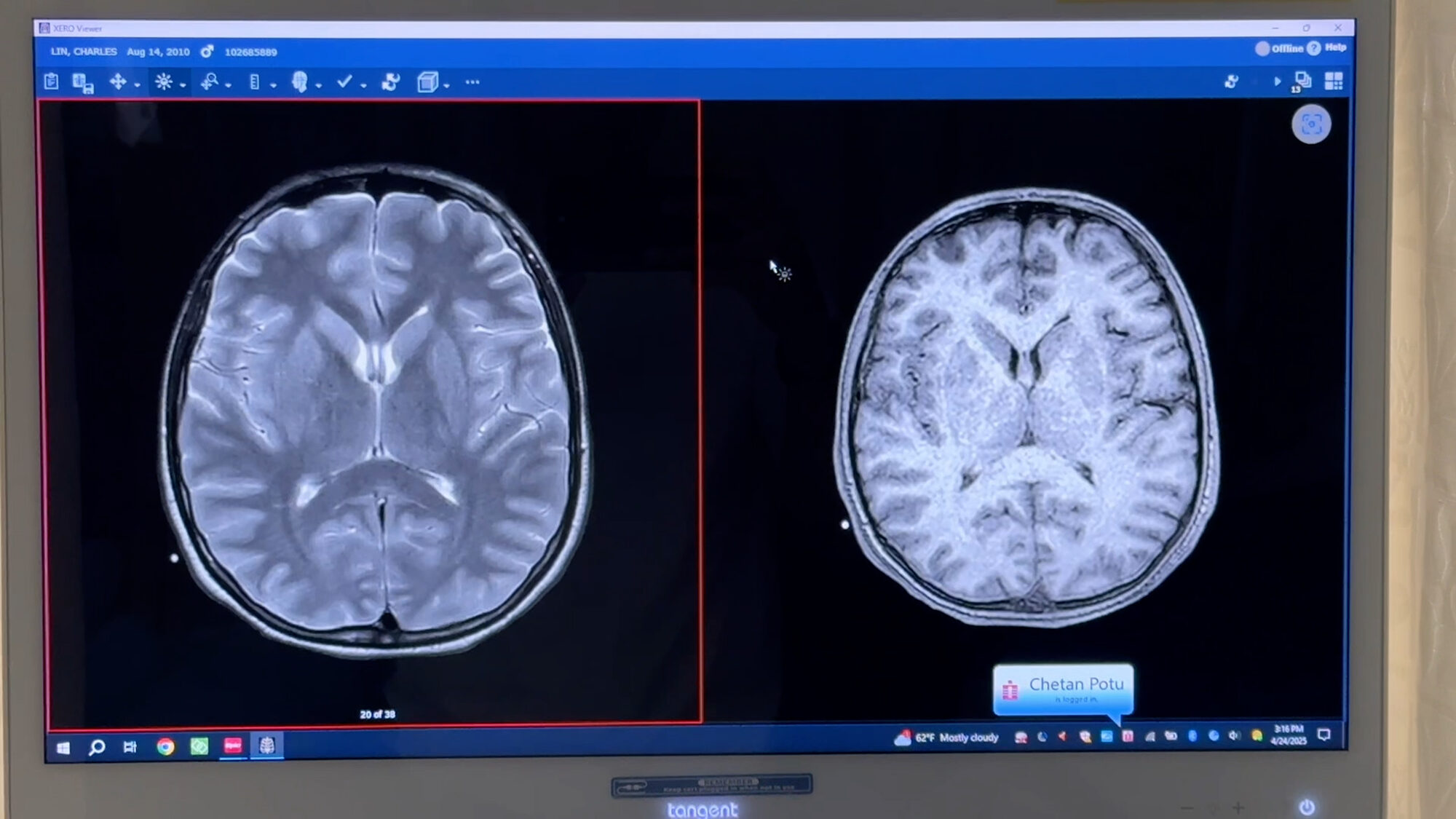
Charlie's brain imaging on a clinical monitor

Brain Recovery

The six-month window after injury when the brain rebuilds fastest, and what a family can do inside it.

Head Safety and Helmet Design

Charlie's injury sparked a helmet project with Giro. The film follows that work and what it could change.

Sound and Music as Medicine

Gongs, tuning forks, and a guitar Charlie could play before he could hold a conversation.

Charlie drawing a bow

Movement, Play and Joy

Archery, slacklining, and skiing as rehabilitation. Joy treated as a clinical tool.

The kitchen table protocol of supplements and daily practice

Nutrition and Supplementation

The kitchen table protocol. What went into him every day for a year, and why.

A Mammoth Lakes fire engine on the highway below the Sierra

Rural Emergency Response

The nearest advanced care is an hour out by aircraft. Time is not a friend at these distances, and you still cannot rush.

Family holding each other in the ICU room

Community and Care

Recovery ran on people. Teammates, neighbors, doctors, patrollers, and strangers who showed up.

Why the butterfly

Transformation

Through the year of Charlie's recovery, he and his father raised monarchs in the house.

A caterpillar does not grow into a butterfly. Inside the chrysalis it breaks down almost completely, closer to liquid than to an animal, then rebuilds from a small cluster of cells that was there the whole time.

Charlie's brain did a version of the same thing. The film was in the room for both.

Sun setting over the Owens Valley
Death Valley is the lowest place on the continent. Mammoth sits near the highest. Highway 395 runs between them.
Independent filmmaking

It started as a camera
in a hospital room.

No one set out to make this film. The camera was in the room because storytelling was the tool Albert had, and the one thing he could still hand his son.

This is Charlie's story. He lived it and we captured it, and the practice of framing it was itself the therapy.

Albert has spent a life telling stories, and telling them is how he got through his own. Losing his leg taught him to take authorship of what was happening and shape it with intention. When Charlie woke with a year of rebuilding ahead of him, that was what Albert had to hand him.

Johnny Harrington, creative director of Epic Productions and one of Albert's closest friends, moved in for over a year. Trust built through constant presence, day after day, until the camera stopped being something anyone noticed. That is where the moments come from, the ones nobody could have scheduled or asked for.

A perfect storm, then. Nobody would have greenlit a camera in that room on the first day. The film exists because the people in the room were the people making it, and that is the same reason it can finish on its own terms.

  • Final cut stays with the filmmakers.
  • The film runs as long as the story needs.
  • It premieres at festivals, where a documentary like this one finds its first audience.
  • The impact campaign gets built with partners already working in these fields.

Finishing it ourselves is the honest position, and it is why this page exists.

How it was backed

National Geographic backed development, and that work is in the film. When the network's long range budget timeline shifted, they offered the rights back to us freely and unencumbered rather than hold the picture in place. Their position was that this is an award-worthy story that should not sit in purgatory. We are grateful for that, and we took them up on it.

Filmmakers
  • Albert LinCo-Director and Executive Producer
  • Johnny HarringtonCo-Director and DP
  • Laura Wolf SteinExecutive Producer
  • Hunter BlissField Producer
  • Epic ProductionsProduction Company
Also in the film
  • Deena KastorAmerican marathon record holder
  • Alana NicholsParalympic gold medalist, High Fives Foundation
  • Alex HonnoldClimber
  • Dr. Andrew SkalskyNeurologist
  • Kelsey BoyerFounder, Save A Brain
A single voice made of many
Charlie Lin in interviewCharlieThe subject
Albert Lin in interviewAlbertHis father
Teammate in interviewP.Teammate, first on scene
Friend in interviewO.Friend
Scott McGuire in interviewScott McGuireFire chief, Mammoth Lakes
Progress report

Principal photography is complete.

The story is shot, all the way through the return to Mammoth in April 2026. The film is now moving into post.

DevelopmentComplete
Principal PhotographyComplete, April 2026 *
Post ProductionIn progress
Festival PremiereNext
ReleaseTo come

* Shot with partial support from National Geographic. How it was backed

Premiere

Festival first. Mountainfilm, Telluride, SXSW, Tribeca, Sundance.

Release

Independent release through streaming or direct distribution, chosen once the film is finished.

Impact

A run through hospitals, schools, and ski communities, built alongside the pillar partners.

Where the film needs hands

Post is where a strong documentary becomes a great one.

Four places we want help.

01

Score and Sound Design

The film lives on sound. We are looking for a composer and a sound team who hear what this could be.

02

Graphics and CGI

Making the invisible visible. Neural animation, wearable data, and the visual language of a brain rebuilding itself. This is the most ambitious part of the film and the part with the most upside.

03

Color

A colorist who can hold the line between raw iPhone ICU footage and 2000fps RED, and make it one film.

04

Edit Support

Additional editors and assistants to work through a year of material with the story team.

A monarch resting on Charlie's face Charlie relearning to stand in the rehabilitation room Albert's prosthetic leg clicking into a ski boot The frozen lake below Mammoth Mountain
How to back it

This is a passion project with a professional ceiling.

Four ways in.

Finishing Partner

Capital toward post. Credit, premiere access, and a seat in the room while the film is finished.

Executive Producer

For partners who want a producing role and a stake in where the film goes.

Impact Partner

Organizations working in brain injury, youth sport, head safety, or recovery. Your work becomes part of the campaign the film carries.

Craft Partner

Post houses, composers, VFX artists, and colorists contributing work in kind. Full credit and a share of the film's life beyond the premiere.

Talk to us

Let us talk.